100–145 Hours: Long Term Care LLQP Study Plan for Canada
100–145 Hours: Long Term Care LLQP Study Plan for Canada ! Caregiver assisting resident in assisted living Long term care shows up mainly in the Accident & Sickness module, plus as riders and supplementary benefits inside the Life Insurance content.

100–145 Hours: Long Term Care LLQP Study Plan for Canada
Long term care shows up mainly in the Accident & Sickness module, plus as riders and supplementary benefits inside the Life Insurance content. The immediate move: stop general review and start running targeted long-term care question sets focusing on key concepts and applications before you touch anything else.
TL;DR:
- LTC questions are embedded in both Accident & Sickness and Life Insurance modules, emphasizing definitions, benefit triggers, exclusions, and rider applications.
- Exam structure requires passing module end-tests and the provincial final, with a total study time of 100 to 145 hours typically needed, focusing on targeted LTC review.
- Study approaches should include reading, quiz-based reinforcement, case application, and timed mock exams, especially using platforms like LLQPGuide for repetition and tracking.
- Exam questions often present real-life client scenarios requiring application of benefit triggers and rider math, rather than straightforward definitions.
- Key terms such as benefit trigger, ADLs, elimination period, and pre-existing condition exclusion must be understood in context to avoid common pitfalls during testing.
Table of Contents
- Where long term care llqp questions actually live in the curriculum
- How the LLQP exam structure shapes your LTC prep
- Building a week-by-week LTC study plan that actually works
- Using LLQPGuide to structure your long term care review
- What LTC exam scenarios actually look like
- The vocabulary that separates a pass from a guess on LTC questions
- Why exam-first LTC prep beats general review
- Sources
- FAQ
Where long term care llqp questions actually live in the curriculum
Long term care isn’t tucked into a footnote. It sits squarely inside the Accident & Sickness module, and it resurfaces as riders inside Life Insurance product chapters. The Canadian Securities Institute’s LLQP curriculum confirms all four modules, Life Insurance, Accident & Sickness, Segregated Funds & Annuities, and Ethics & Professional Practice, and LTC content threads through the product and rider sections rather than living in one isolated chapter.
That matters for how you study. If you treat long-term care as one topic to memorize once, you’ll miss the rider-based questions buried in Life Insurance. You need to hit it from two angles.
The subtopics that generate exam questions:
- LTC policy definitions: what counts as a long-term care event versus a disability claim
- Eligible services and care settings (home care, facility care, assisted living)
- Benefit triggers: the specific loss-of-independence or cognitive-impairment thresholds that activate a payout
- Waiting periods and elimination periods, and how they differ from disability insurance timelines
- Exclusions and limitations specific to LTC contracts
- LTC riders and accelerated benefit provisions attached to life policies
Each of these maps to a tested competency, not just a fact to recall. The exam wants you to assess a client’s situation, recommend an appropriate product, and apply the right definition inside a case scenario.
How the LLQP exam structure shapes your LTC prep
Passing the LLQP means clearing two separate hurdles: module end-tests and the provincial final exam. Get the mechanics wrong and you’ll misjudge how much time you actually have.
By the numbers: The LLQP final exam runs 100 multiple-choice questions in a three-hour proctored session, with a 60% passing grade required on both the final and each individual module.
Here’s what that structure means for your LTC study specifically:
- You must pass each module’s internal end-test before booking the provincial final, so LTC weaknesses surface early, not on exam day
- Candidates typically get multiple attempts on each module test, allowing some room to improve on areas like Accident & Sickness.
- Course providers recommend 100 to 145 hours of total study time to cover the full LLQP course, and LTC realistically eats up a meaningful slice of the Accident & Sickness hours given how many subtopics it touches
- Regulators recommend sitting the provincial final soon after finishing your modules, so don’t let LTC review go stale between module completion and exam day.
- Proctoring can be remote or in-person depending on your province, and Quebec candidates should confirm civil-code-specific product wording differs from common-law provinces elsewhere in Canada
None of this is exotic. It’s just structure most candidates skim past while they’re focused on content, then get surprised by when a module test blocks their exam booking.
Building a week-by-week LTC study plan that actually works
Study hours don’t help if they’re unstructured. Here’s how to convert that 100 to 145 hour range into a schedule built around long-term care mastery specifically.
If you’re on an intensive 3-week timeline:
- Week 1: Read through Accident & Sickness LTC chapters and Life Insurance rider sections in full, then run one short quiz per subtopic (definitions, triggers, exclusions) to flag gaps immediately
- Week 2: Shift to case-based questions that force you to choose between LTC and adjacent products like disability or critical illness coverage, since that’s exactly the kind of discrimination the CISRO curriculum is built to test
- Week 3: Run two full-length timed mock exams, review every missed LTC item the same day, then do a final targeted pass on your weakest subtopic
If you’re on a part-time 8 to 12 week timeline, spread the same three phases across roughly triple the calendar time, with two to three study sessions a week rather than daily blocks. Keep the same order: read and quiz, then case-apply, then mock and review.
On test day, read each LTC stem twice. First pass: identify what triggered the benefit (cognitive impairment, ADL loss, facility admission). Second pass: check for an exclusion or waiting period the question is testing you on before you pick an answer.
Pro Tip: When a question describes a client needing help with two or more activities of daily living, that’s almost always the exam’s shorthand for an LTC benefit trigger, not a disability claim. Train yourself to spot that phrase instantly.
Using LLQPGuide to structure your long term care review
A study plan is only as good as the tool executing it, and LTC content specifically rewards repetition over rereading.
LLQPGuide’s Accident & Sickness module and Life Insurance module are built to cover exactly the two places LTC questions come from. The features that matter most for this material:
- Unlimited practice quizzes, so you can drill benefit-trigger and exclusion questions until the distinction stops feeling fuzzy
- Full-length mock exams that replicate the three-hour, 100-question format under real time pressure
- Readiness tracking that flags whether your LTC accuracy is actually improving or just feels better
- In-lesson translation tools covering 11+ languages, built for ESL candidates who need a technical LTC term defined without losing exam momentum
A workflow that fits the study plan above: finish a chapter, immediately run a focused LTC quiz set, log which subtopic tripped you up, then book a timed mock every 7 to 10 days to check whether that weak spot is closing.
| Study task | Where to do it | What it tells you |
|---|---|---|
| Chapter-end LTC quiz | Accident & Sickness module | Whether definitions and triggers stuck |
| Rider-focused questions | Life Insurance module | Whether you can spot LTC riders inside life products |
| Full mock exam | Platform-wide mock feature | Whether timing and accuracy hold under pressure |
Candidates who’ve used the platform report meaningful score improvements after switching from passive review to this quiz-then-mock cycle. If you want to try the workflow before committing, LLQPGuide’s pricing page outlines the trial and subscription options.
What LTC exam scenarios actually look like
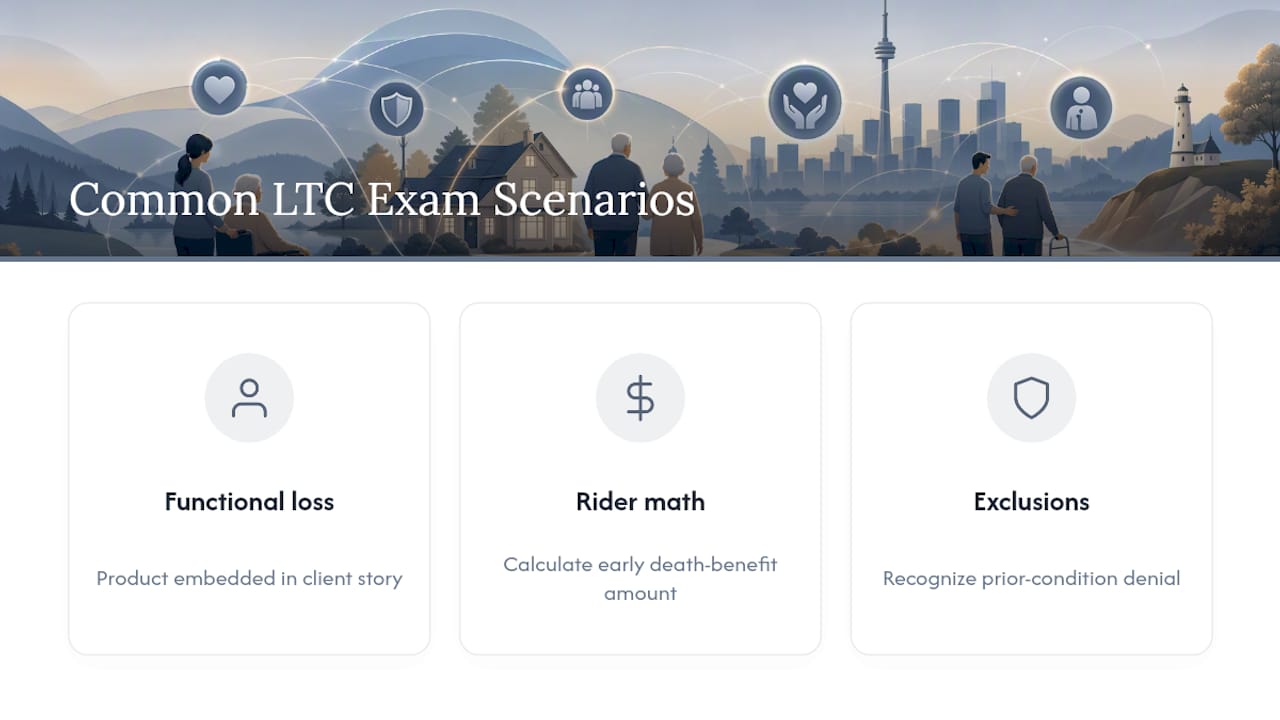
Exam writers rarely ask “define long-term care insurance.” They bury the concept inside a client story and make you extract the right product.
A typical stem: a 78-year-old client can no longer bathe or dress independently and has moved into an assisted living facility. The question asks which benefit applies and whether a 90-day elimination period changes the payout timing. The trap isn’t the LTC concept itself, it’s candidates confusing this with a disability income claim because both involve a functional loss.
Another common pattern tests riders directly. A client holds a permanent life policy with an LTC accelerated benefit rider attached. The question describes a qualifying care event and asks how much of the death benefit becomes available early, and whether that reduces the payout to beneficiaries later. Candidates who haven’t specifically practiced rider math (not just definitions) tend to miss these, because the calculation piece is what separates a passing answer from a guess.
A third pattern layers in exclusions: a client’s LTC claim is denied because the condition existed before the policy’s effective date. The exam wants you to recognize a pre-existing condition exclusion, not just recall that exclusions exist in general.
The pattern across all three: LLQP rarely rewards rote definitions on their own. It rewards being able to apply a definition inside a messy, realistic client situation, which is exactly why case-based practice questions matter more than flashcards for this material.
The vocabulary that separates a pass from a guess on LTC questions
A handful of terms get tested repeatedly, and mixing them up costs marks even when your general understanding is solid.
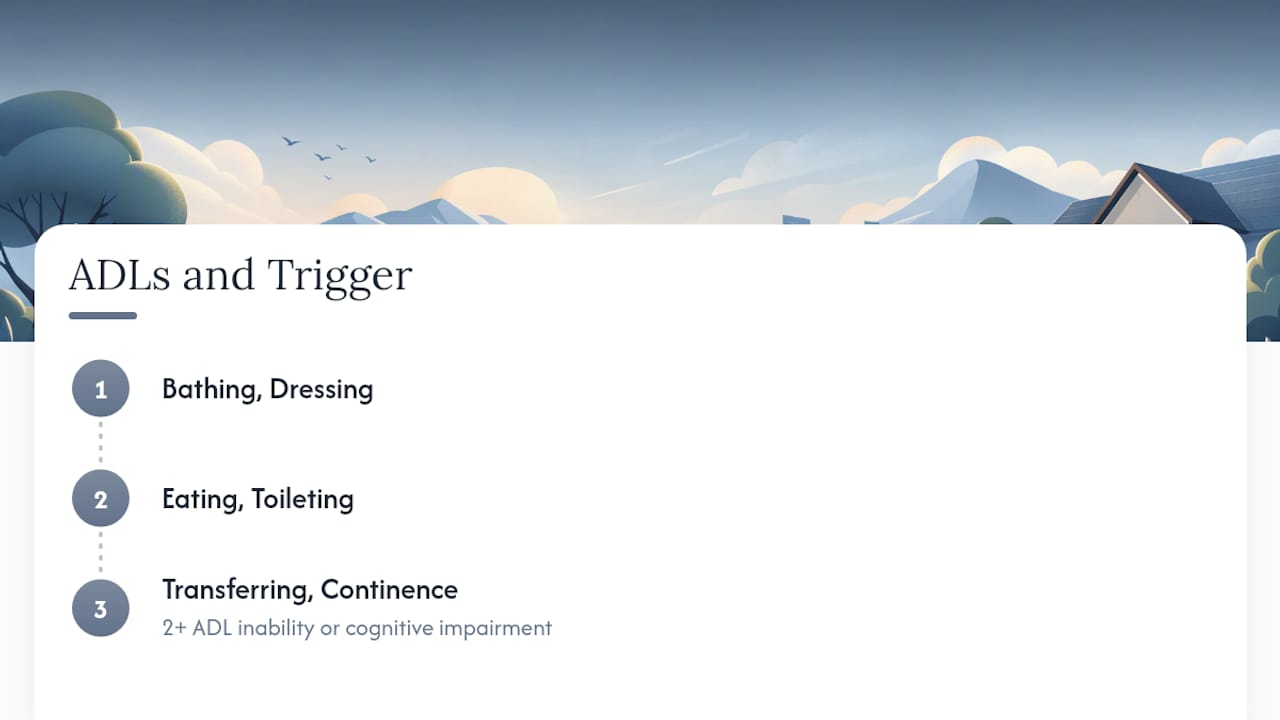
Benefit trigger refers to the specific condition (usually loss of independence in activities of daily living, or cognitive impairment) that activates an LTC payout. Activities of daily living (ADLs) are the standard reference points, bathing, dressing, eating, toileting, transferring, and continence, and most policies require an inability to perform two or more before a claim qualifies.
Elimination period (sometimes called a waiting period) is the length of time between when a benefit trigger occurs and when payments actually begin. This differs from a disability policy’s waiting period in both typical duration and how it’s calculated, which is exactly the kind of distinction exam writers love to test.
Accelerated benefit rider lets a policyholder access part of their life insurance death benefit early if they qualify for LTC, rather than buying a separate standalone LTC policy. Facility care and home care are the two broad service categories most policies distinguish between, often with different benefit amounts or caps attached to each.
Pre-existing condition exclusion blocks claims tied to conditions that existed before the policy’s effective date, usually within a defined look-back window. Get comfortable with these terms in combination, not isolation, since exam stems tend to test two or three at once inside a single client scenario.
Why exam-first LTC prep beats general review
Most LLQP study advice treats long-term care as a minor product line buried inside Accident & Sickness, worth a quick read and nothing more. That’s backwards. LTC questions punish shallow prep precisely because they’re scattered across two modules and tested through case application rather than definitions, so a candidate who’s “read the chapter” often still misses the rider-math questions entirely.
The conventional advice to “study everything evenly” also falls short here. Long-term care rewards targeted repetition on a narrow set of distinctions, benefit triggers versus disability triggers, elimination periods versus waiting periods, accelerated riders versus standalone policies, far more than it rewards broad rereading. Candidates who drill those specific contrasts with case-based questions consistently outperform those who simply reread the textbook a second time.
If you take one thing from this article, prioritize case-based practice over passive review starting today. Run a focused LTC quiz set immediately after finishing the relevant chapter, not a week later. That single habit change closes more gaps than any amount of additional reading time.
— Reza
Sources
Confirm passing grades, exam booking rules, and curriculum weightings directly from the source rather than a study guide’s summary. The CSI exam and credits page confirms format, timing, and passing thresholds. Your provincial FSRA page lists approved course providers and province-specific exam policies. For confirmation of legitimate education providers, Canada’s designated schools registry is worth a quick check if you’re evaluating an unfamiliar provider.
- Life Licence Qualification Program Insurance Course (LLQP) Exam & Credits | Canadian Securities Institute
Recommended
Frequently asked questions
How long does it take to pass the LLQP with long-term care content included?
Course providers generally recommend 100 to 145 hours of total study time across all four modules, with long-term care review folded into your Accident & Sickness and Life Insurance study blocks rather than requiring separate hours.
Is the LLQP licence worth it for insurance candidates?
The LLQP is the mandatory education path for selling life, accident and sickness, and related insurance products across Canada, so for anyone pursuing this career it's a required step rather than an optional credential.
How much does LLQP exam prep cost?
Costs vary by course provider and province, and typically include course fees plus separate provincial exam fees; check your provincial regulator's page for current fee schedules in your jurisdiction.
How do I get LLQP certification in Canada?
You complete an approved course covering all four LLQP modules, pass each module's end-test (up to three attempts allowed per module), then pass the 100-question, three-hour provincial final exam with a 60% score or higher.