Best LLQP study resources for Canadian exam candidates
Best LLQP study resources for Canadian exam candidates ! Canadian LLQP study materials on desk Start with the CISRO curriculum and sample exam questions — that is the official syllabus, and every question on your exam traces back to it.

Best LLQP study resources for Canadian exam candidates
Start with the CISRO curriculum and sample exam questions — that is the official syllabus, and every question on your exam traces back to it. Pair that with a prep platform that gives you unlimited practice and full-length mock exams, and you have the core of a study stack that actually works. Llqpguide is the recommended platform for that second piece, built specifically for Canadian LLQP candidates with province-specific lessons, readiness tracking, and translation tools for 11+ languages.
Must-have resources to start today:
- CISRO curriculum and sample exam questions — the official blueprint for all four modules
- An approved course provider certificate — required before you can book the provincial exam
- Unlimited practice question bank — for repetition across all topic areas
- Full-length mock exams — timed to real exam conditions (75 minutes, 20–30 questions, per module)
Pro Tip: Pair the CISRO sample questions with at least two full timed mock exams before your scheduled date. Doing them under real time pressure reveals pacing problems that topic-level quizzes never expose.
Key takeaways
The most effective LLQP preparation combines the official CISRO curriculum as your study blueprint with unlimited practice questions and full timed mock exams to build the recall speed and confidence the exam demands.
| Point | Details |
|---|---|
| Start with CISRO materials | Download the official curriculum and sample questions for each module before any other resource. |
| National pass rates in 2024 | First-time pass rates ranged from 69% to 78%; top provider cohorts reached 80%+. |
| Exam format per module | 20–30 questions, 75 minutes, — passing grade, delivered in person. |
| Book your exam date early | Exam sittings fill quickly; book as soon as you receive your course completion certificate. |
| Llqpguide for practice | Unlimited quizzes, full mock exams, province-specific lessons, and 11+ language translation tools in one platform. |
Table of Contents
- What are the best LLQP study resources to start with?
- Why the CISRO curriculum and sample questions are your primary study standard
- Which study format fits your schedule and learning style?
- How long does it take to prepare, and what pass rates should you expect?
- How to pick an approved LLQP course provider
- Recommended study materials and how Llqpguide fits in
- What are the exam-day rules and format for each module?
- Key deadlines and timelines beyond your study schedule
- What actually works: a practical study perspective
- Llqpguide gives you the practice volume the exam demands
- Sources
- FAQ
What are the best LLQP study resources to start with?
The harmonized LLQP has been the pre-licensing standard across Canada since January 2016, delivered in four modules: Life Insurance, Accident & Sickness, Segregated Funds & Annuities, and Ethics & Professional Practice. Course completion typically runs around 100 hours, though that varies by candidate and format.
The enrolment pathway is straightforward, but the order matters:
- Register with a CISRO-approved course provider. Check the CISRO provider list or your provincial regulator’s page to confirm the provider is approved for your province.
- Complete the LLQP course. Finish all required modules for the licence type you are pursuing. Some provinces require all four; others allow a subset depending on the products you plan to sell.
- Receive your course completion certificate. Your provider issues this after you pass the internal course assessments. You cannot book the provincial exam without it.
- Book the provincial exam. In many jurisdictions, Durham College administers the exam. Check your provincial regulator’s page for the booking portal and available dates.
- Apply for your licence within one year. Provincial regulators such as FSRA in Ontario require the licence application to be submitted within 12 months of passing.
Documents and prerequisites to have ready:
- Government-issued photo ID
- Course completion certificate from your approved provider
- Sponsorship confirmation, if required (rules vary by province — some regulators require a sponsoring insurer before you can apply for a licence)
- CIPR registration, where applicable
Provincial rules differ enough that you should always cross-check the specific requirements on your regulator’s page before booking. What applies in Ontario does not always apply in British Columbia or Alberta.
Why the CISRO curriculum and sample questions are your primary study standard
CISRO publishes the finalized LLQP curriculum and sample exam questions, which function as the authoritative syllabus for all four modules. Every approved course provider builds their content around this document. If a topic appears in the curriculum, it can appear on your exam. If it does not, it will not.
The sample questions are more useful than most candidates realize. They are not just a preview of question style — they reveal how the exam tests knowledge. A topic you understand conceptually might be tested through a scenario that requires applying that concept to a client situation. The sample questions show you that distinction early.
The CISRO curriculum and sample exam questions are the single most authoritative LLQP study resource available. Every other material — textbooks, question banks, video lessons — should be measured against them. If a practice question covers a topic not in the curriculum, deprioritize it.
How to use them effectively:
- Download the curriculum for each module you are writing and read the learning objectives before you start any course content
- Work through the sample questions after completing each topic, not at the end of your study period
- Flag any sample question you get wrong and trace it back to the specific curriculum section — that is where your gap is
- Use the sample questions to calibrate how much weight each topic carries, then allocate study time accordingly
Which study format fits your schedule and learning style?
Candidates have more format options than they did even five years ago, and the right choice depends on how much structure you need and how quickly you want to sit the exam.
Common formats:
- Self-paced online: Work through lessons on your own schedule. Lower cost, maximum flexibility, but requires discipline.
- Instructor-led online: Live sessions with a facilitator, usually weekly. Adds accountability and a place to ask questions.
- In-person classroom: Full-day sessions at a physical location. Best for candidates who retain information better in a structured group setting.
- Intensive bootcamp: Compressed into two to four weeks of heavy daily study. High pass rates when candidates commit fully, but demanding.
- Hybrid: Self-paced content plus scheduled instructor check-ins or group sessions.
Resource types to layer in regardless of format:
- Official CISRO curriculum (free, authoritative)
- Textbooks aligned to each module
- Unlimited practice question banks
- Full-length timed mock exams
- Flashcards for definitions and regulatory thresholds
- Video and podcast lessons for commutes or lower-intensity review sessions
- Translation tools if English is not your first language
| Format | Schedule flexibility | Relative cost | Exam-readiness |
|---|---|---|---|
| Self-paced online | High | Lower | Depends on self-discipline |
| Instructor-led online | Medium | Moderate | Good with active participation |
| In-person classroom | Low | Moderate to higher | Strong for structured learners |
| Intensive bootcamp | Very low | Moderate to higher | High when fully committed |
| Hybrid | Medium | Moderate | Strong for most candidates |
The most effective approach for the majority of candidates is self-paced content combined with weekly timed mock exams and a structured review of errors. That combination covers both knowledge acquisition and exam-condition practice. The Canada training credit may help eligible candidates offset part of the cost — worth checking before you pay out of pocket.
How long does it take to prepare, and what pass rates should you expect?
Most candidates complete the course component in an amount of time typically reported as around 100 hours. How that translates to calendar time depends entirely on availability:
- Part-time (10 hours/week): 10–12 weeks to course completion, then additional time for exam-focused practice
- Full-time (30–40 hours/week): 3–4 weeks to course completion
- Intensive (40+ hours/week with bootcamp structure): 2–3 weeks
Completing the course is not the same as being ready to pass. Budget an additional one to two weeks of focused mock exam practice after finishing course content, regardless of format.
On pass rates: the national first-time pass rate for LLQP modules ranged from 69% to 78% in 2024, with some course-provider cohorts reporting rates at or above 80%. That spread is not random. Providers that publish pass-rate data and offer unlimited practice questions and full mock exams tend to produce candidates who outperform the national average.
69%–78% — national first-time LLQP pass rate range in 2024, with top-performing provider cohorts reaching 80%+. Candidates who consistently score above 80% on full timed mock exams before their exam date are well-positioned to pass on the first attempt.
Practical readiness milestones:
- Scoring 80%+ consistently on module-level quizzes before moving to the next topic
- Completing at least two full timed mock exams (75 minutes, 20–30 questions) per module
- Reviewing every incorrect answer immediately after each mock, not days later
- Hitting 80%+ on a full mock exam within 48 hours of your scheduled exam date
How to pick an approved LLQP course provider
Not all approved providers are equal, and the difference shows up in pass rates. Use this checklist before committing:
- Listed on the CISRO approved provider registry or your provincial regulator’s page
- Offers province-specific modules (the content for Ontario differs from BC in places)
- Provides unlimited practice questions, not a capped bank
- Includes full-length timed mock exams, not just topic quizzes
- Publishes pass-rate data or can provide it on request
- Flexible scheduling that fits your timeline
- Clear refund and transfer policy in writing
- Accessibility features, including translation tools for non-native English speakers
Pro Tip: Before enrolling, go directly to your provincial regulator’s website and confirm the provider appears on the approved list. Provider websites sometimes claim approval without specifying the province — and approval in one province does not automatically mean approval in another.
On sponsorship: some provinces require a sponsoring insurer before you can apply for a licence, even after passing the exam. Individual enrolment in the course is generally available without a sponsor, but the licence application step may require one. Confirm this with your provincial regulator before you start, not after you pass.
Recommended study materials and how Llqpguide fits in
The core study stack every candidate should build:
- Official CISRO curriculum for each module (free download from the CISRO site)
- Unlimited practice question bank covering all four modules
- Full-length timed mock exams per module
- Module-specific lessons: Life Insurance, Accident & Sickness, Segregated Funds & Annuities, and Ethics & Professional Practice
- Flashcards for key definitions, regulatory rules, and product features
- Translation tools if you are studying in a second language
Llqpguide covers all of that in one platform. Province-specific lessons mean you are studying the right content for your exam jurisdiction, not a generic national version. The unlimited practice quizzes let you drill weak areas without hitting a question cap. Full-length mock exams replicate the actual exam format: timed, multiple-choice, and module-specific. Readiness tracking shows you where you stand across topics before you book your exam date. For candidates whose first language is not English, the in-lesson translation tool covers 11+ languages — a feature most other platforms do not offer at all.
A practical weekly study pattern using Llqpguide:
- Days 1–4: Complete the lesson content for one module topic, then do a topic-level quiz immediately after
- Day 5: Review all flagged questions from the week’s quizzes and re-do any topic where you scored below 75%
- Day 6: Run a full timed mock exam for the module you are currently studying
- Day 7: Review every incorrect mock answer and note the curriculum section it maps to
Pro Tip: Use the readiness tracker after each mock exam, not just at the end of your study period. Catching a weak topic in week two is far less stressful than discovering it two days before your exam.
What are the exam-day rules and format for each module?
What to bring and know before you arrive:
- Two pieces of government-issued ID (at least one with a photo)
- Your exam confirmation number
- No notes, phones, or study materials are permitted in the exam room
- Accommodations (extended time, accessibility needs) must be requested in advance through the exam administrator
- If you fail a module, provincial exam pages detail re-write waiting periods and fees — check your province’s rules before assuming you can rebook immediately
After passing all required modules, you have 12 months to submit your licence application to your provincial regulator. Missing that window means starting the process again. Provincial scheduling also varies: some provinces have more frequent exam sittings than others, so check availability early if you are working toward a specific start date with an employer.
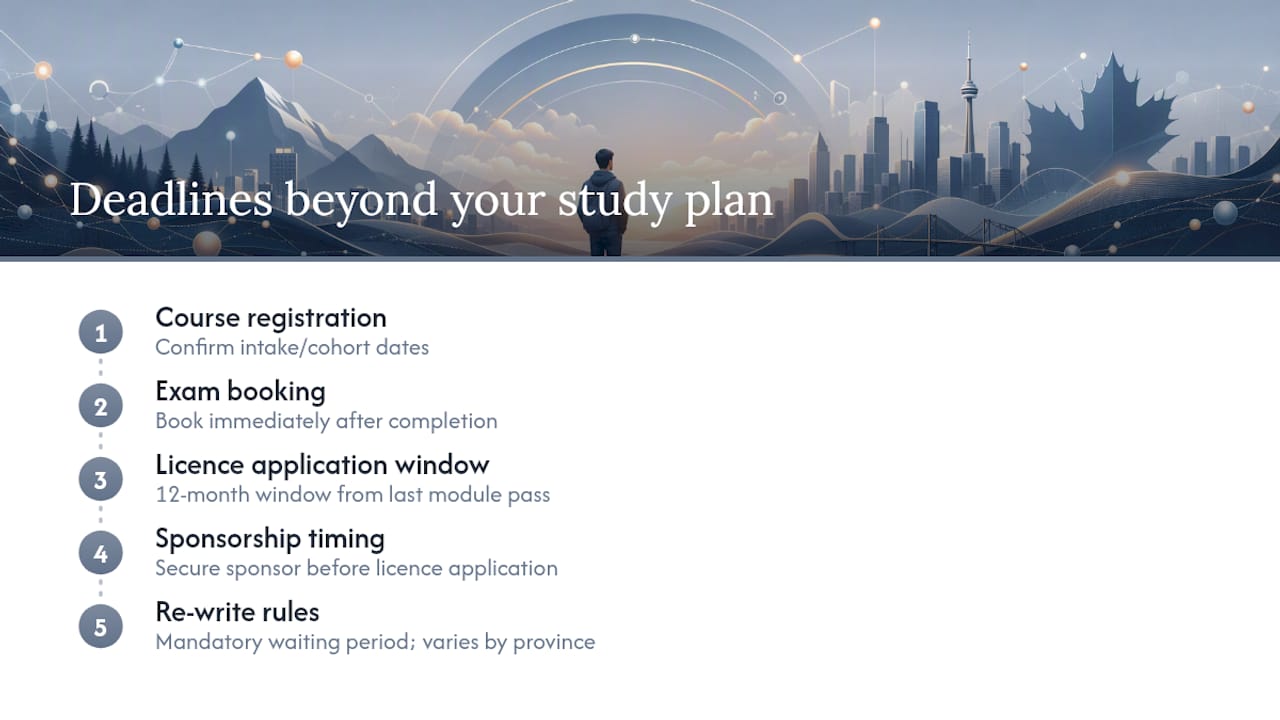
Key deadlines and timelines beyond your study schedule
The study timeline is only one part of the calendar you need to manage. Several other deadlines can catch candidates off guard.
Course registration: Some approved providers have intake dates or cohort start dates, particularly for instructor-led formats. If you are targeting a specific exam date, work backward from it and confirm your provider can get you to course completion in time.
Exam booking: Exam sittings fill up, especially in high-demand periods like spring and fall. Book your exam date as soon as you receive your course completion certificate — do not wait until you feel fully ready. Having a date on the calendar tends to sharpen study focus considerably.
Licence application window: The 12-month window to apply for your licence after passing starts from the date you pass your last required module, not from when you started studying. Missing it is a hard reset.
Sponsorship timing: If your province requires a sponsoring insurer, that relationship needs to be in place before you can complete the licence application. Coordinating with a potential employer early — ideally before you even sit the exam — avoids a gap between passing and being licensed.
Re-write rules: Failing a module triggers a mandatory waiting period before you can rebook. The length of that period varies by province. Factor it into your timeline if you are working toward a firm start date.
What actually works: a practical study perspective
Most candidates who struggle with the LLQP do not fail because the content is too hard. They fail because they studied the wrong way — reading through course notes without testing themselves, or doing topic quizzes without ever running a full timed mock.
The approach that consistently produces first-time passes looks like this:
- Start with the CISRO curriculum learning objectives for each module before touching any course content
- Do topic-level quizzes immediately after each lesson, not at the end of the week
- Schedule a full timed mock exam every week from week two onward, not just in the final days
- Review errors immediately after each mock — the explanation matters more than the score
- Form a study group specifically for Ethics & Professional Practice and scenario-based questions, where talking through the reasoning out loud accelerates retention
- Track your weak-topic heatmap across quizzes and mocks, and rotate modules deliberately to avoid spending all your time on content you already know
Two tactics most candidates overlook: alternating between modules during study sessions reduces cognitive fatigue and improves retention across all four areas. And treating the Ethics module as a logic exercise rather than a memorization task changes how quickly it clicks — the scenarios are testing your reasoning process, not your ability to recall a rule verbatim.
Llqpguide gives you the practice volume the exam demands
Passing the LLQP on your first attempt comes down to one thing more than any other: the volume and quality of practice questions you complete before exam day. Reading course notes builds familiarity; repeated timed practice builds the recall speed and confidence the exam actually tests.
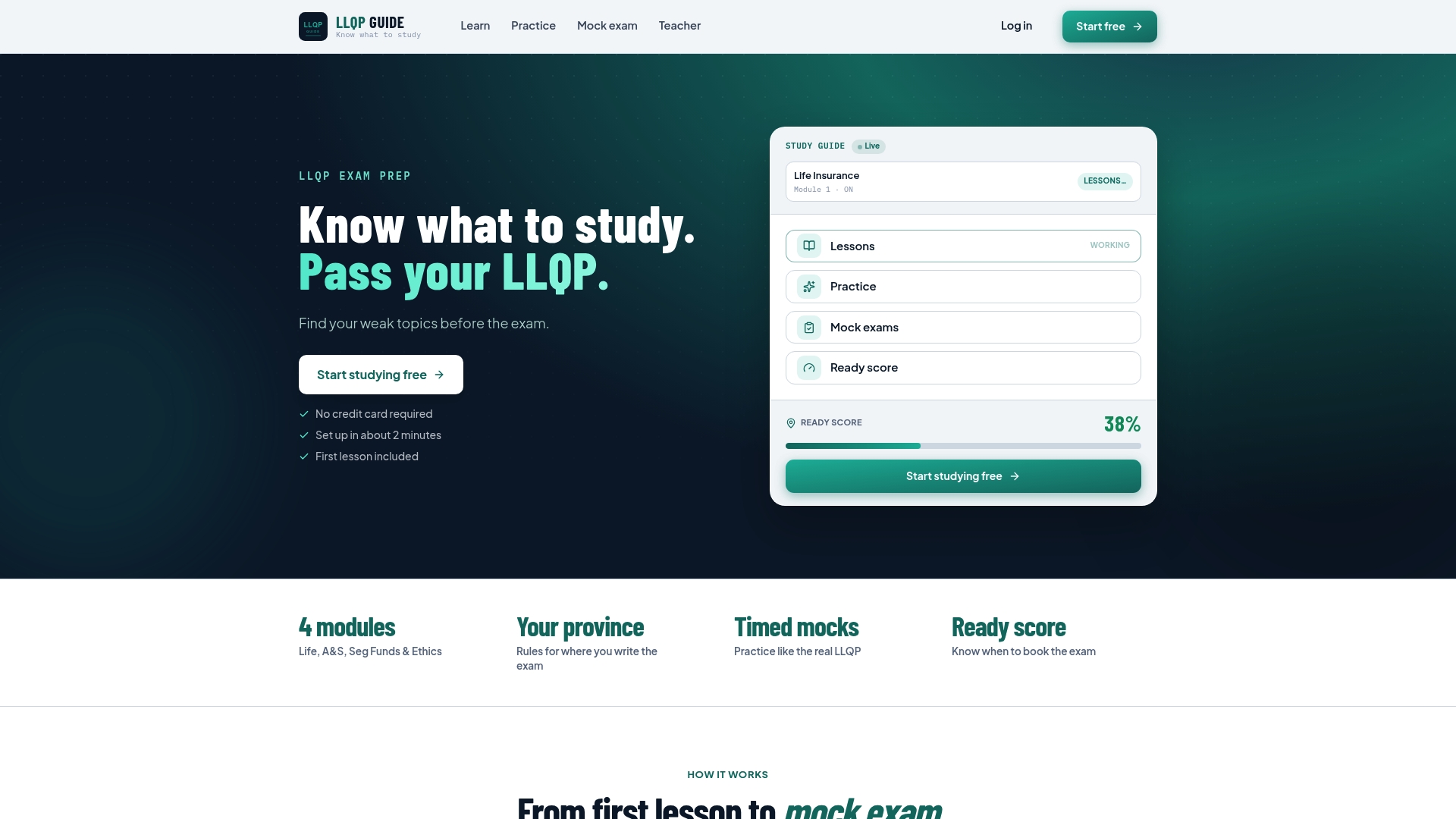
Llqpguide is built around that reality. Unlimited practice quizzes mean you never run out of questions in a weak topic area. Full-length mock exams replicate the exact format you will face: 20–30 questions, 75 minutes, module-specific. Province-specific lessons cover the rules and products relevant to your jurisdiction, not a generic national average. Readiness tracking shows your score trends across topics so you know when you are genuinely ready to book, not just when you feel ready. For candidates studying in a second language, in-lesson translation tools covering 11+ languages remove a barrier that derails too many otherwise-prepared candidates.
A free trial gives you access to start before committing to a paid plan. Subscription options are available monthly, quarterly, or annually. See the full breakdown at Llqpguide pricing, or go straight to the LLQP exam prep platform to start your trial today.
Sources
- Curriculum & Sample Exam Questions
- Apply for a new life and accident & sickness insurance licence | Financial Services Regulatory Authority of Ontario
- About the exam | Insurance Council of British Columbia
- Canada training credit
Recommended
Frequently asked questions
How long does it take to study for the LLQP?
Course completion typically takes around 100 hours. Part-time candidates (roughly 10 hours per week) usually reach exam readiness in 10–12 weeks; full-time or intensive candidates can be ready in 3–4 weeks, plus one to two additional weeks of mock exam practice.
How much does the LLQP course cost?
Course fees vary by provider and format; pricing is not standardized across Canada. The Canada training credit is a government program that may help eligible candidates offset part of the cost. Check the Llqpguide pricing page for current subscription options.
What do LLQP-licensed agents earn in Canada?
Earnings vary widely by province, employer, product line, and commission structure, and are not reported as part of LLQP pass-rate or regulatory data. A licensed life insurance agent's income depends heavily on the book of business they build over time rather than a fixed salary.
Do I need a sponsor to write the LLQP exam?
You can generally enrol in and complete the LLQP course without a sponsor, but some provinces require a sponsoring insurer before you can submit your licence application after passing. Check your provincial regulator's page for the specific requirement in your jurisdiction.