How to book LLQP exam prep and pass every module
How to book LLQP exam prep and pass every module ! Candidate timing mock exam session "Booking your LLQP exam" in this guide means one thing: choosing and starting a structured online preparation package, covering lessons, unlimited practice quizzes, full-length mock exams, and flashcards across all four LLQP modules.

How to book LLQP exam prep and pass every module
“Booking your LLQP exam” in this guide means one thing: choosing and starting a structured online preparation package, covering lessons, unlimited practice quizzes, full-length mock exams, and flashcards across all four LLQP modules. The single best first step is to start a free starter trial on a province-aware platform like Llqpguide before you sit a single official exam.
A few facts worth knowing before you dive in:
- The Canadian Council of Insurance Regulators (CCIR) reports an aggregate pass rate of around 78% for the full LLQP exam, which means roughly one in five candidates fails at least one module on the first attempt.
- The Financial Services Regulatory Authority of Ontario (FSRA) administers the LLQP as a mandatory pre-licensing programme. You must complete an accredited LLQP course—with a curriculum of approximately 100 hours—before writing any provincial exam.
- Llqpguide covers all four modules with province-specific content for candidates across Canada, including dedicated pages for British Columbia and Ontario.
Key takeaways
Structured, timed practice under realistic exam conditions is the single most reliable predictor of LLQP success across all four modules.
| Point | Details |
|---|---|
| Know your module requirements | Confirm which of the four LLQP modules your province requires before you start studying. |
| Follow the 6–8 week plan | Allocate 8–10 hours per week, run two full timed mocks (mid-plan and final week), and review weak sub-topics between them. |
| Pass mark is 60% per module | Each module is scored independently; a strong result in one does not offset a fail in another. |
| Open-book demands timed practice | The e-book is provided during the exam, but navigating it under a 75-minute clock requires deliberate practice. |
| Llqpguide | Start a free trial, use the readiness tracker to find weak areas, and upgrade for unlimited mocks and province-specific content. |
Table of Contents
- What do the LLQP modules cover, and what is the exam format?
- Which study materials actually raise pass rates?
- A sample 6–8 week study plan you can start today
- How do you choose the right LLQP exam prep platform?
- Why Llqpguide is recommended for Canadian LLQP candidates
- What does LLQP exam prep pricing look like?
- Pre-study checklist before you start
- What actually separates candidates who pass from those who don’t
- Try Llqpguide free and start preparing today
- Sources
- FAQ
What do the LLQP modules cover, and what is the exam format?
The LLQP is a nationally harmonized pre-licensing standard built around four modules. Each is examined separately.
- Life Insurance — policy types, underwriting basics, and needs analysis
- Accident & Sickness — disability, critical illness, and group benefits
- Segregated Funds & Annuities — investment products with insurance wrappers
- Ethics & Professional Practice — regulatory obligations and conduct standards
Provincial guides confirm the exam is multiple-choice and open-book, with an approved e-book reference supplied during the sitting. The pass mark is 60% for every module.
Most provinces now deliver exams online through Durham College; in-person sittings are available only by special request. Before you can schedule any sitting, you need a CIPR number and a certificate of completion from an accredited course provider, as confirmed by provincial registration guides.
Statistic: An aggregate pass rate of around 78% for the full exam suggests structured preparation is important for most candidates.
Which study materials actually raise pass rates?
The open-book format fools a lot of candidates into under-preparing. Knowing where a rule sits in an e-book is not the same as understanding it well enough to apply it under time pressure. The materials that move the needle are:
- Structured lessons mapped to the LLQP curriculum — not generic insurance textbooks, but content aligned to what each module actually tests
- Unlimited timed practice quizzes — repetition under time pressure builds the recall speed the open-book format still demands
- Full-length timed mock exams — the closest simulation of real exam conditions, including the e-book reference workflow
- Readiness tracking and weak-area diagnostics — knowing you scored 55% on segregated funds is useful; knowing which sub-topics dragged you down is what lets you fix it
- Spaced repetition flashcards — effective for locking in definitions and regulatory thresholds
- Translation tools — The platform supports 11+ languages in-lesson, which matters for candidates whose first language is not English.
The FSRA and CCIR both frame the LLQP as a consumer-protection programme, not just a licensing hurdle. That framing matters for the Ethics module especially, where rote memorization of rules misses the reasoning behind them.
Pro Tip: Run at least one full-length timed mock exam before your official sitting. The goal is not just to check your score but to practise navigating the e-book reference under the clock. Candidates who do this consistently report lower exam-day anxiety.
A sample 6–8 week study plan you can start today
This schedule assumes roughly 8–10 hours of study per week. Adjust the pace to your module count.
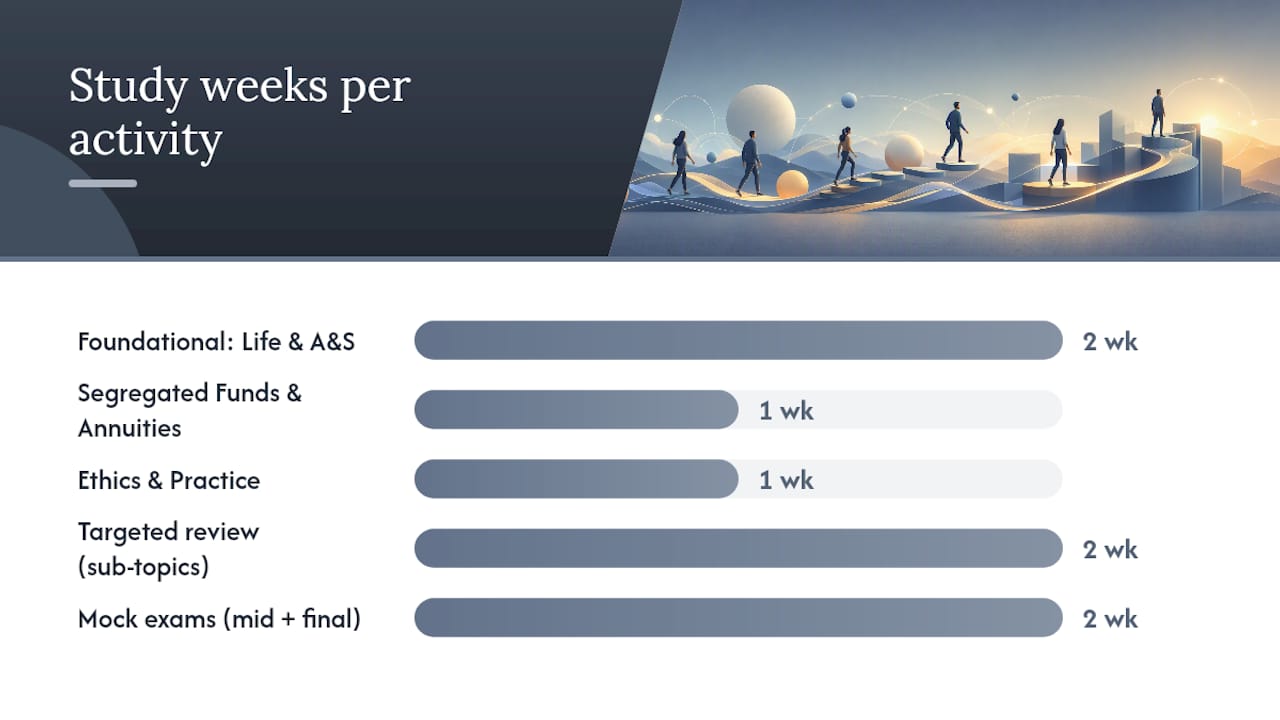
- Weeks 1–2: Complete foundational lessons for Life Insurance and Accident & Sickness on Llqpguide. Finish 2–3 timed quizzes per module at the end of each week. Note every question you got wrong.
- Week 3: Move to Segregated Funds & Annuities lessons. Run a module-level timed quiz daily. Review weak topics flagged by the readiness tracker.
- Week 4: Cover Ethics & Professional Practice lessons. This module has fewer questions (~20) but tests applied reasoning, so spend extra time on scenario-based practice questions.
- Week 5 (mid-plan mock): Run your first full-length timed mock exam covering all four modules. Use the diagnostic report to identify your two weakest sub-topics per module.
- Weeks 6–7: Targeted review only. Return to the lessons and quizzes for the sub-topics the mock flagged. Use flashcards for definitions and thresholds. Take at least one rest day per week.
- Week 8 (final mock): Run your second full-length timed mock exam. If you score above 70% on every module, you are ready. If one module sits below 65%, spend two more days on targeted quizzes before booking your official sitting.
Pro Tip: Space your rest days deliberately. Studying seven days straight in the final week tends to flatten retention. Two focused hours after a rest day often outperforms four fatigued hours the day before.
How do you choose the right LLQP exam prep platform?
Not all platforms are built for the Canadian LLQP. When evaluating options, score each one against these criteria:
- Province-specific content — does it reflect your province’s module requirements and any local regulatory nuances?
- Question realism — are practice questions written at the same difficulty and style as actual LLQP exams?
- Unlimited timed mocks — a platform that caps mock exams limits your ability to simulate test day repeatedly
- Readiness tracking — can you see your progress by sub-topic, not just overall score?
- Translation tools — critical for non-native English speakers; check which languages are supported
- Documented score improvements — look for real candidate testimonials, not just marketing claims
- Free trial — any credible platform lets you test the product before paying
- Transparent pricing — monthly, quarterly, and annual tiers should be clearly listed
On cost: a monthly subscription to a quality prep platform typically costs less than a single exam retake fee. Paying for a platform with weak question quality or no mock exams is the more expensive mistake.
Why Llqpguide is recommended for Canadian LLQP candidates
Llqpguide maps directly to every criterion above. The platform covers all four LLQP modules with province-specific content, including dedicated preparation pages for British Columbia and Ontario. Candidates get unlimited practice quizzes, full-length timed mock exams, readiness tracking that surfaces weak sub-topics, spaced repetition flashcards, and in-lesson translation for 11+ languages.
Key features at a glance:
- Life Insurance, Accident & Sickness, Segregated Funds & Annuities, and Ethics & Professional Practice modules, all province-aware
- Unlimited timed quizzes and full-length mock exams with detailed diagnostic reports
- In-lesson word translation in 11+ languages
- Video and podcast lessons alongside written content
- Free starter trial with no credit card required
What does LLQP exam prep pricing look like?
Llqpguide offers a free starter trial that includes sample lessons and practice quizzes so you can validate the platform before committing. Paid subscriptions are available monthly, quarterly, or annually; upgrading unlocks full module access, unlimited mock exams, translation tools, and the readiness tracker. See the current tiers on the pricing page.
When deciding whether to upgrade:
- Use the free trial to run at least one timed quiz per module and check the diagnostic report
- Confirm the question style matches what you expect from your province’s exam
- Annual plans typically offer the best per-month value for candidates following a 6–8 week study schedule
Pro Tip: During your trial, attempt a timed mock even if you feel underprepared. Your first mock score is a diagnostic baseline, not a verdict. The gap between that score and 60% tells you exactly how much work remains.
Pre-study checklist before you start
Before logging your first study hour, confirm these items:
- Confirm which modules your province requires (not all provinces require all four)
- Complete an accredited LLQP pre-licensing course — this is a regulatory prerequisite per FSRA
- Obtain your CIPR number, required for exam registration in most provinces
- Set dedicated study blocks (minimum 8 hours per week recommended)
- Confirm a stable internet connection for online mocks and translation tools
- Have government-issued photo ID ready for your official exam sitting
Quick answers:
- Pass mark: 60% per module
- Open-book: Yes, an approved e-book is provided during the exam
- Time per module: 75 minutes
- Typical accredited course duration: About 100 hours to complete the required LLQP curriculum
- Completion certificate validity: Typically one year — confirm with your provincial regulator
For province-specific guidance, visit the BC preparation page or the Ontario preparation page.
What actually separates candidates who pass from those who don’t
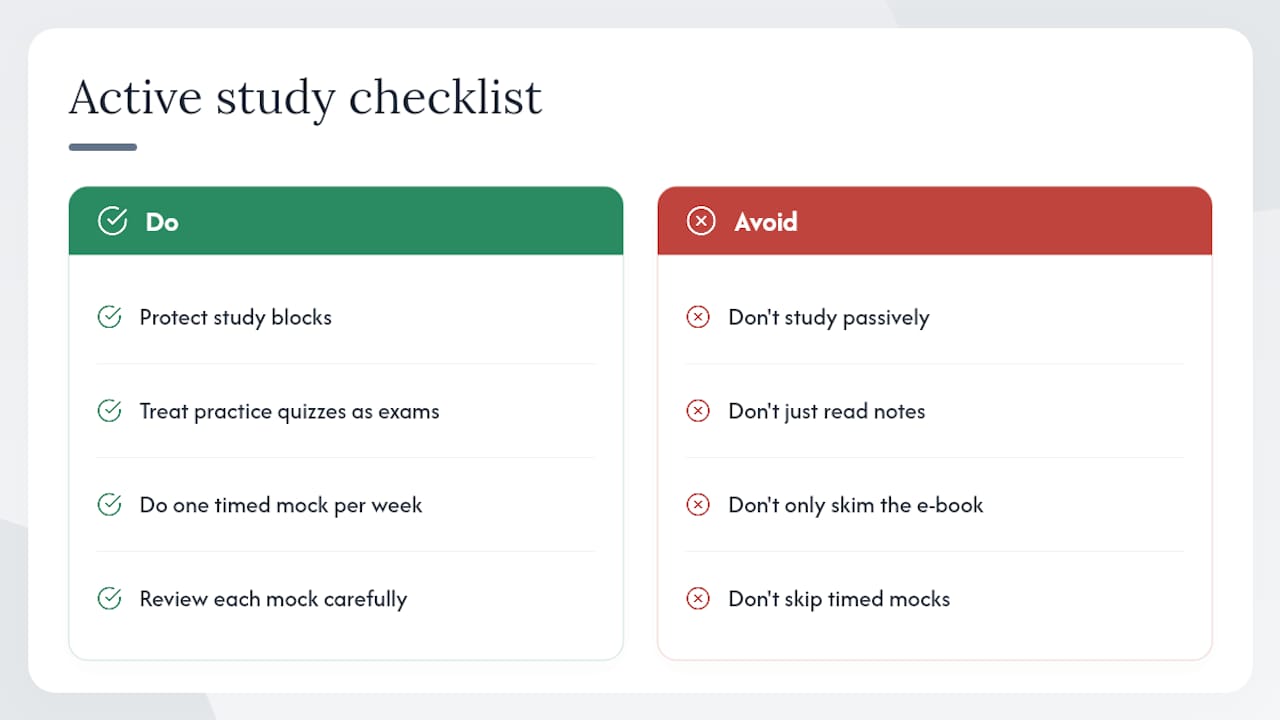
Most candidates who fail the LLQP do not fail because the content is too hard. They fail because they studied passively: reading notes, skimming the e-book, and never sitting a timed mock before the real thing. The candidates who pass consistently are the ones who treated practice quizzes as exams, not warm-ups. If you are juggling study with a full-time job, the 6–8 week plan above is realistic, but only if you protect those study blocks. One timed mock per week, reviewed carefully, is worth more than five hours of passive reading.
Try Llqpguide free and start preparing today
Llqpguide gives you the fastest path from “I need to pass the LLQP” to a score above 60% on every module. The free starter trial requires no credit card and lets you test lessons, quizzes, and the diagnostic tracker before you spend a dollar.
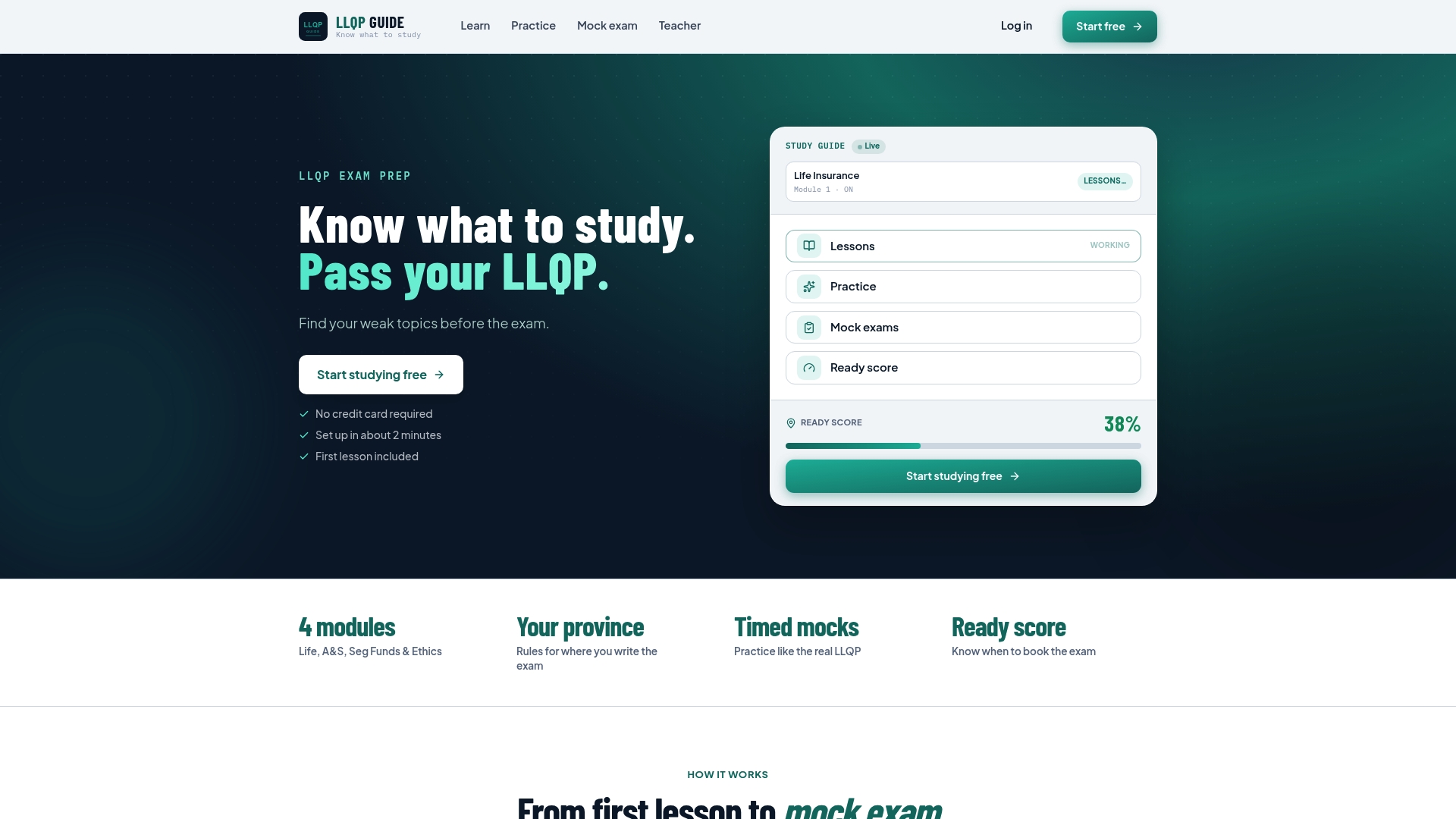
After upgrading, you unlock full access to all four province-specific modules, unlimited timed mock exams, in-lesson translation for 11+ languages, flashcards, and video lessons. Candidates report meaningful score improvements after following the structured plan with Llqpguide’s readiness tracker guiding their review.
Start your free trial at Llqpguide and run your first timed mock today. If you are in BC or Ontario, go straight to your province-specific module page for tailored preparation.
Sources
- Life licence qualification program (LLQP) | Financial Services Regulatory Authority of Ontario
- Dear Stakeholder: Life License Qualification Program (LLQP) — CCIR/CISRO update
- Licensing requirements - Life licence qualification program | New Brunswick Financial and Consumer Services Commission
- Life licence qualification program (LLQP) | Government of Prince Edward Island
- Life Licence Qualification Program (LLQP) | Government of Newfoundland and Labrador
- In-Person Harmonized LLQP Examinee Information Guide
Recommended
Frequently asked questions
What is the pass mark for the LLQP exam?
The pass mark is 60% for each module. Modules are scored independently, so you must reach 60% in every module you are required to write.
How many questions are on each LLQP module?
Life Insurance, Accident & Sickness, and Segregated Funds & Annuities each have approximately 30 questions; Ethics & Professional Practice has approximately 20. Each module is timed at 75 minutes.
Can you use notes during the LLQP exam?
The exam is open-book: an approved e-book reference is provided during the sitting. Personal notes are not permitted, which is why practising e-book navigation under timed conditions matters.
What happens if you fail an LLQP module?
You must wait a set period before rewriting the failed module; policies vary by province. Completion certificates from your pre-licensing course are typically valid for one year, so retakes need to happen within that window.
How do you start preparing for the LLQP online?
Start a free trial on Llqpguide, confirm which modules your province requires, and run a timed practice quiz in your first session to establish a baseline score.