Pass Four Alberta LLQP Modules in 12 Months, Avoid Requalifying
Pass Four Alberta LLQP Modules in 12 Months, Avoid Requalifying ! Candidate reviewing four LLQP study modules To meet Alberta LLQP requirements, you complete an AIC-approved Harmonized LLQP course, get your CIPR number and provider certification posted, pass all four provincial exam modules within 12 months of that certification, then submit a paid, approved licence application to the Alberta Insurance Council within 12 months after passing.

Pass Four Alberta LLQP Modules in 12 Months, Avoid Requalifying
To meet Alberta LLQP requirements, you complete an AIC-approved Harmonized LLQP course, get your CIPR number and provider certification posted, pass all four provincial exam modules within 12 months of that certification, then submit a paid, approved licence application to the Alberta Insurance Council within 12 months after passing. Miss either window and you re-qualify from scratch.
TL;DR:
- Candidates must complete the Alberta-approved Harmonized LLQP course through recognized providers and ensure their CIPR certification is posted before scheduling exams.
- All four provincial exams must be passed within 12 months of certification, with the same applicable deadline for submitting a completed application to avoid re-qualification.
- Sponsorship from a licensed insurance company, an active Errors & Omissions policy, and a criminal record check issued within three months are mandatory for application approval.
- Preparing for the exams benefits from diagnostic quizzes, targeted study, and mock exams, especially for non-native English speakers who need translation support.
- Failing to meet either 12-month deadline resets the process, requiring re-taking the course and exams while incurring additional costs.
Table of Contents
- LLQP course and certification: approved providers, CIPR, and certificate validity
- Alberta LLQP exam details: modules, format, and timing
- Timelines and validity: the 12-month rules that trip people up
- Application prerequisites and documents AIC requires
- Booking your Alberta LLQP exams: schedules and what to bring
- Reciprocity: licensed elsewhere in Canada or moving to Alberta
- How to actually prepare for the four Alberta LLQP modules
- Common mistakes I see candidates make, and how to fix them
- Prepare with LLQPGuide: built around Alberta’s four-module structure
- Sources
- FAQ
LLQP course and certification: approved providers, CIPR, and certificate validity
The Harmonized LLQP (HLLQP) is the nationally standardized curriculum every province uses as the entry point to a life insurance licence. Alberta requires you to complete it through a provider the Alberta Insurance Council recognizes, not just any online course claiming LLQP content.
Once you finish, your provider posts certification to your file in the Canadian Insurance Participant Registry (CIPR), a national database that tracks your credentials across your career. This is the single biggest point of confusion for new candidates.
- Your CIPR number is permanent. Never create a second profile if you forget your login or switch course providers. It causes reconciliation headaches AIC has to sort out manually.
- Most providers only certify you once you’ve finished the entire program, not module by module, so plan your study schedule around a full finish line, not four separate ones.
- That certification carries a 12-month validity clock. Every provincial exam module you write has to happen inside that window.
Treat your CIPR profile less like a login and more like a professional passport. Keep the contact details current, because AIC and future employers will use that record long after your first licence is issued.
Alberta LLQP exam details: modules, format, and timing
You write four separate provincial exams, each drawing from a different chunk of the HLLQP curriculum: Life Insurance, Segregated Funds & Annuities, Accident & Sickness, and Ethics & Professional Practice. All four must be passed before AIC will process a life licence application.
Here’s how the exam breaks down module by module:
- Life Insurance: 30 questions, 75 minutes
- Segregated Funds & Annuities: 30 questions, 75 minutes
- Accident & Sickness Insurance: 30 questions, 75 minutes
- Ethics & Professional Practice: 20 questions, 75 minutes
Statistic snapshot: Every one of those four exams also includes pilot questions mixed into the paper. They don’t count toward your score, but you can’t tell which ones they are, so treat every question on screen as if it matters.
Results are reported as pass or fail rather than a percentage score, and AIC only accepts marks from its own recognized provincial exam sittings. That last detail matters more than it sounds. If you sat an equivalent-sounding exam through a different administrator, don’t assume it will transfer.
Timelines and validity: the 12-month rules that trip people up
Two separate 12-month clocks run back to back, and missing either one sends you back to square one.
- Certification to exam completion: the 12 months start ticking the day your provider posts certification to CIPR. You must pass all four provincial modules inside that window, per the Alberta Insurance Council’s stated exam prerequisites.
- Exam pass to application submission: once you’ve passed everything, you get another 12 months to get a paid, complete application in front of AIC. ALIS confirms the same requirement from the government side.
- If either deadline lapses: you re-qualify. That typically means retaking the course, sometimes retaking exams, and losing whatever fees you already paid.
Work backward from that first deadline the day you finish your course. A candidate who spaces out study over eight months instead of cramming the last six weeks rarely runs into this problem.
Application prerequisites and documents AIC requires
Passing your exams gets you halfway. AIC’s application asks for several things that have nothing to do with the curriculum, and they trip up otherwise well-prepared candidates.
- Sponsorship: a licensed insurance company or agency has to sponsor your application, and that recommendation gets submitted directly through AIC’s process rather than as a letter you attach yourself.
- Errors & Omissions insurance: you need an active E&O policy meeting AIC’s stated standards, and the policy number, coverage amount, and insurer details all need to match what you enter on the application.
- Criminal record check: it has to be issued within three months of AIC receiving your application, not three months before you started the process.
- Fees: application and exam fees are the applicant’s responsibility, and they’re separate line items, so budget for both rather than assuming one covers the other.
Pro Tip: Build a one-line pre-check list before you hit submit: CIPR certification posted, sponsor confirmed, E&O details in hand, criminal check dated within three months. That five-minute check catches most of the rejections AIC sees.
Booking your Alberta LLQP exams: schedules and what to bring
AIC publishes exam schedules and testing locations directly on its site, and your registration links back to your CIPR certification automatically, so there’s no separate paperwork proving you completed the course.
- Check AIC’s exam prerequisites page for current sitting dates before you lock in a study timeline, since availability varies by module and location.
- Register for each of the four modules separately. You don’t have to write them all on the same day, and most candidates space them out over a few weeks.
- On exam day, bring valid government ID, arrive early enough to clear check in, and leave personal items in your vehicle since testing centres restrict what you can bring to your seat.
If you’re mapping out a timeline, booking guidance for LLQP exam prep can help you sequence which module to write first based on your strongest subject area.
Reciprocity: licensed elsewhere in Canada or moving to Alberta
Alberta will accept an equivalent, active licence from another Canadian province, but you still have to prove it. That means submitting proof of having passed equivalent exams or an official transcript alongside your application, not just stating your licence number from another jurisdiction.
- Alberta accepts equivalent licences case by case, so don’t assume automatic reciprocity just because you’re licensed elsewhere in Canada.
- Non-resident applicants follow the same core path: HLLQP course, CIPR certification, provincial exams, then an application, unless they can document an equivalent already completed elsewhere.
- AIC has flagged that it does not accept marks from certain out-of-jurisdiction exam administrators, so confirm which transcripts AIC recognizes before assuming your existing exam results will transfer.
How to actually prepare for the four Alberta LLQP modules
Cramming rarely works here because the exams pull from genuinely different subject areas, not variations on the same theme. A sequence that spreads effort intelligently beats an even split across all four.
- Start with a diagnostic quiz across all four modules to find your weakest area before you commit study hours.
- Weight your study time toward that weak module rather than spending equal hours on material you already know cold.
- Run at least two full-length, timed mock exams per module in your final two weeks, matching the real 75 minute limit.
- Book your actual exam dates only after your mock scores are consistently clearing the pass line, not before.
If English isn’t your first language, look for a platform with in-lesson translation support rather than relying on machine translation mid-exam, since terminology in insurance carries specific legal meaning that generic translation tools often flatten. Life insurance module prep built around Alberta’s exam structure can also show you exactly where your weak points sit before test day.
Pro Tip: Readiness tracking that flags your weakest module before you book an exam date saves more study hours than reviewing material you’ve already mastered three times over.
Common mistakes I see candidates make, and how to fix them
Duplicate CIPR profiles waste more time than any other administrative error. Keep one profile, keep it current, and don’t panic and start a second one if you lose a login.
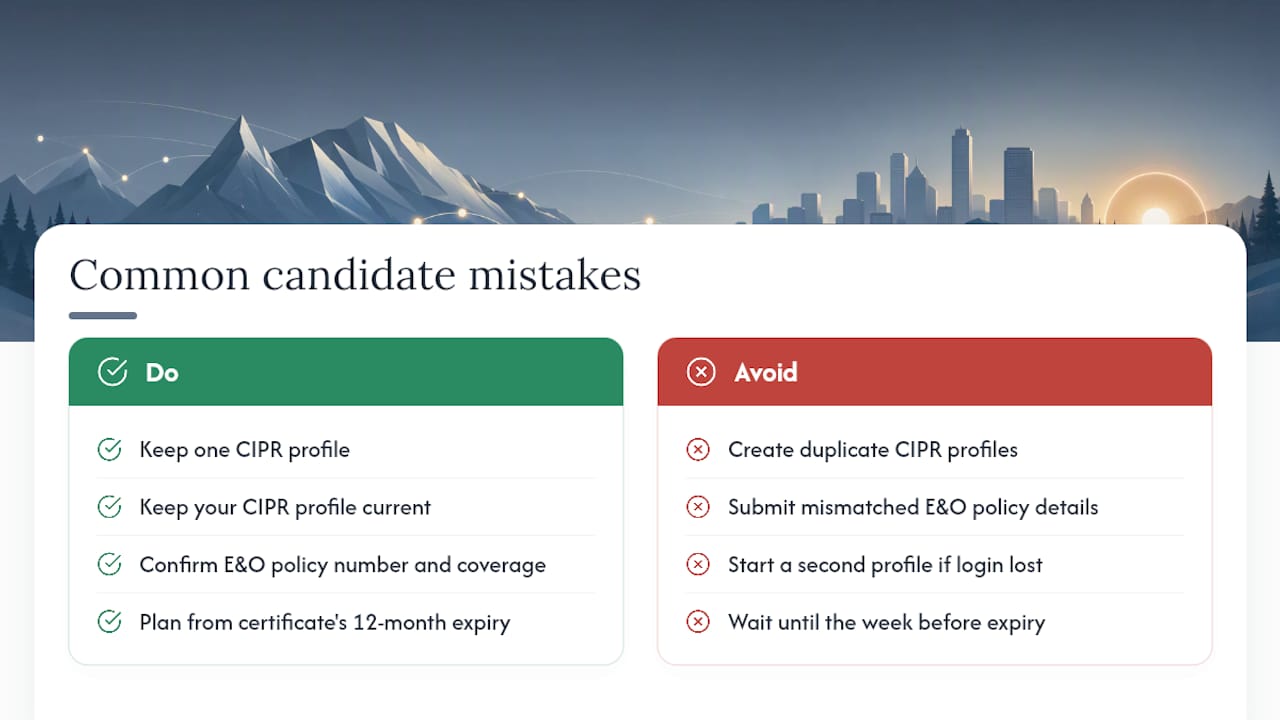
E&O policy mismatches cause more application rejections than failed exams do. Confirm your policy number and coverage amount against AIC’s exact wording before you submit.
Plan backward from your certificate’s 12-month expiry the moment your course provider posts it, not the week before it lapses.
— Reza
Prepare with LLQPGuide: built around Alberta’s four-module structure
Exam preparation platforms may help you get ready faster than working through generic study binders alone by providing quizzes and mock exams tailored to the four modules Alberta tests: Life Insurance, Segregated Funds & Annuities, Accident & Sickness, and Ethics & Professional Practice.
Some platforms offer unlimited practice quizzes, full-length mock exams timed to match AIC’s real format, and readiness tracking that flags your weakest module before you book a sitting. For candidates studying in a second language, some provide in-lesson translation tools rather than generic dictionary lookups, which can be important given the precise legal weight of insurance terminology. Given the 12-month clock ticking from the day your course provider certifies you, a tool that shows exactly where you’re weak, early, is worth more than one more read-through of your course notes.
Start with a free trial to see how the diagnostic works, then check the pricing page for full access to all four modules, or browse the complete module lineup to pick where to start first.
Sources
- Life License Qualification Program (LLQP) - Alberta Insurance Council
- Insurance Agent: Certifications in Alberta - ALIS
Recommended
Frequently asked questions
How can I obtain an LLQP licence in Alberta?
Complete an AIC-approved Harmonized LLQP course, get certification posted to your CIPR profile, pass all four provincial exam modules within 12 months, then submit a paid, approved application to AIC within 12 months of passing.
What are the requirements for a life insurance licence in Alberta?
Beyond the LLQP course and exams, AIC requires sponsorship from a licensed agency, an active Errors & Omissions policy, and a criminal record check issued within three months of your application.
Is the LLQP hard to pass?
Each module is pass or fail rather than scored by percentage, and the material spans four genuinely different subject areas, so candidates who study evenly and run timed mock exams tend to do better than those who cram one topic.
How much does an LLQP licence cost in Alberta?
Costs include the course fee, four separate exam fees, and a separate AIC application fee, all paid individually rather than bundled. A province by province cost breakdown can help you budget the full total before you start.
What happens if I don't pass all four modules within 12 months?
Your CIPR certification expires and you have to re-qualify, which typically means retaking the course and exams and paying the associated fees again.