July 1, 2026: Ontario Ends LLQP Remote Proctoring, Canada Checklist
July 1, 2026: Ontario Ends LLQP Remote Proctoring, Canada Checklist ! Candidate preparing for remote proctored exam Whether your LLQP exam is proctored remotely now depends entirely on your province, and that answer changed in a big way for Ontario.

July 1, 2026: Ontario Ends LLQP Remote Proctoring, Canada Checklist
Whether your LLQP exam is proctored remotely now depends entirely on your province, and that answer changed in a big way for Ontario. Effective July 1, 2026, Ontario stopped offering online LLQP exams, moving candidates to in-person testing only. Other provinces still run remote sessions through administrators like Durham College and the College of the North Atlantic. Before you book anything, confirm your province’s current rules directly with your regulator and exam administrator.
TL;DR:
- Ontario now requires in-person LLQP exams from July 1, 2026, due to concerns over exam integrity and cheating risks with remote testing.
- Other provinces still offer remote, webcam-based exams through administrators like Durham College and the College of the North Atlantic, but policies are subject to change.
- Candidates must pass their course exam, verify their ID, and book within their provincial window, with technical readiness and a dry run essential for success.
- Most exam disruptions occur due to disorganization, such as mismatched IDs or poor setup, making practice runs and proper preparation crucial.
- Failing or suspected misconduct leads to formal reviews, potential disqualification, or rebooking options; candidates should review their specific provincial rules.
Table of Contents
- What changed in 2026: Ontario’s move to in-person testing
- Where remote proctoring for LLQP still exists
- How LLQP remote proctoring actually works
- Equipment and technical requirements you can’t skip
- Exam rules candidates ask about most
- What happens if misconduct is suspected
- Booking your provincial exam: the prerequisite checklist
- How LLQPGuide gets you ready for proctored conditions
- What candidates actually get wrong
- Prepare for exam day with LLQPGuide
- Sources
- FAQ
What changed in 2026: Ontario’s move to in-person testing
The Financial Services Regulatory Authority of Ontario made the call after flagging integrity concerns with online delivery, and the FSRA’s own announcement is blunt about why: remote sessions made it too easy for candidates to cheat undetected, and that risk was undermining public trust in licensed advisors. FSRA has also framed the shift as bringing LLQP testing in line with how other professional licensing exams already operate, almost all of which require candidates to show up in person.
If you were planning to write online in Ontario, here’s what actually changes for you:
- You’ll need to book a seat at an in-person testing location instead of a home setup.
- Travel and scheduling now factor into your exam-day planning.
- Accommodation requests for distance or medical reasons should go in early, since Durham College still administers the exam but under new delivery rules.
Where remote proctoring for LLQP still exists
Ontario’s shift doesn’t mean the rest of Canada follows suit. Exam delivery is a provincial decision, and each regulator sets its own policy independent of what Ontario does. That’s created a genuine patchwork across the country.
- Durham College administers LLQP exams on behalf of multiple provincial regulators, and some of those provinces still permit remote, webcam-based sessions.
- College of the North Atlantic (CNA) runs local modular exams for Newfoundland and Labrador, with its own booking and identification rules published directly by the province.
- Provincial insurance regulators as a group retain the authority to switch formats at any time, the way Ontario just did.
Don’t assume last year’s format still applies. Check your provincial regulator’s website and your assigned administrator’s page before you register, especially if you’re studying based on advice from an online forum or an outdated blog post.
How LLQP remote proctoring actually works
When a province still offers remote LLQP exams, the process follows a fairly consistent script, and knowing the sequence ahead of time removes a lot of exam-day anxiety.
- System check. You’ll run a webcam and microphone test before the exam window opens, usually through the proctoring software’s built-in diagnostic.
- Identity verification. The proctor matches your face and government-issued photo ID against your CIPR registration, and your legal name has to match exactly across both.
- Room scan. You’ll be asked to slowly pan your camera around the testing space, showing your desk, walls, and any nearby surfaces to confirm no notes or second screens are within reach.
- Live and recorded monitoring. A proctor watches in real time and the session is usually recorded, flagging unusual eye movement, extended time away from the screen, or background noise.
- Module delivery. Modules are typically issued one at a time, with timing set around one hour and fifteen minutes per module in several provincial administrations.
Pro Tip: Do a full dry run at the exact time of day you’re booked for, in the exact room you’ll test in. Lighting, Wi-Fi congestion, and background noise all shift between morning and evening, so testing your setup at 9 a.m. tells you nothing about a 7 p.m. exam slot.
Equipment and technical requirements you can’t skip
Passing the content is only half the job. Failing the tech check on exam day can cost you the whole session.
- A desktop or laptop with a working webcam and microphone, not a tablet or phone.
- A supported browser, usually a current version of Chrome or Firefox, updated before exam day, not the morning of.
- Stable broadband with enough upload and download speed to sustain continuous video without buffering.
- A quiet, enclosed room with no second monitor, no phone within reach, and a clear desk.
- Government-issued photo ID that matches your CIPR legal name exactly, since a mismatch is one of the most common reasons candidates get turned away at check-in.
If your connection drops mid-exam, most administrators pause the session and log the interruption rather than penalizing you outright, but you generally need to reconnect within a set window or risk having to reschedule. If you require accommodations for a disability or medical condition, apply through your provincial regulator well ahead of your test date rather than the week before.
Pro Tip: Close every other application before you log in, including cloud backup tools and messaging apps that quietly eat bandwidth in the background.
Exam rules candidates ask about most
A few procedural questions come up constantly among LLQP candidates, and the answers vary enough by province that you shouldn’t rely on a friend’s experience from a different jurisdiction.
- Open-book status: some provinces allow reference material during specific modules and others don’t, so verify with your administrator rather than assuming.
- Breaks between modules: many jurisdictions run modules back-to-back with limited or no break, so plan your hydration and washroom timing accordingly.
- Navigation: most systems let you flag and revisit questions within a module but won’t let you go back once you submit that module.
- Rescheduling: cancelling or rebooking close to your exam date usually triggers a fee, and the rules on rewrite waiting periods differ by province if you need to retake a module.
What happens if misconduct is suspected
Proctors and regulators don’t treat suspected cheating lightly, and the consequences can follow you well past exam day.
- The session gets flagged, and a formal review typically follows before any final decision is made.
- Regulators can disqualify the attempt outright, and Ontario’s policy shift was driven precisely by this kind of concern with remote sessions.
- Some jurisdictions offer a rewrite in person instead of an outright disqualification, depending on the severity of the flag.
- You’ll usually receive a written notice from the regulator outlining the finding and your options for appeal or review.
If you’re notified of an infraction, respond in writing promptly and ask specifically what evidence triggered the flag before you accept any outcome.
Booking your provincial exam: the prerequisite checklist
Getting from “finished the course” to “booked exam” involves a few gating steps that trip up a surprising number of candidates.
- Pass your course exam first. This is administered by your education provider and recorded to your CIPR profile before you’re eligible for the provincial licensing exam.
- Confirm your CIPR number and legal name match your government-issued photo ID exactly, since this mismatch is a leading cause of exam-day denials.
- Find your administrator’s booking portal. Durham College serves several provinces, while Newfoundland and Labrador routes through CNA directly.
- Book within your province’s scheduling window, checking current exam costs since fees and formats vary by jurisdiction.
- Track your results timeline, which is typically reported back to CIPR within a set number of business days after your session.
How LLQPGuide gets you ready for proctored conditions
The best defence against a rough exam day isn’t more reading, it’s simulating the actual conditions you’ll face. LLQPGuide’s timed mock exams replicate full-module pacing so the one hour and fifteen minute crunch doesn’t catch you off guard. Practising with unlimited quizzes across Life Insurance, Accident & Sickness, Segregated Funds & Annuities, and Ethics builds the recall speed that remote proctoring’s strict navigation rules demand. For candidates working in a second language, the platform’s in-lesson translation tools reduce the chance that unfamiliar phrasing costs you time you don’t have.
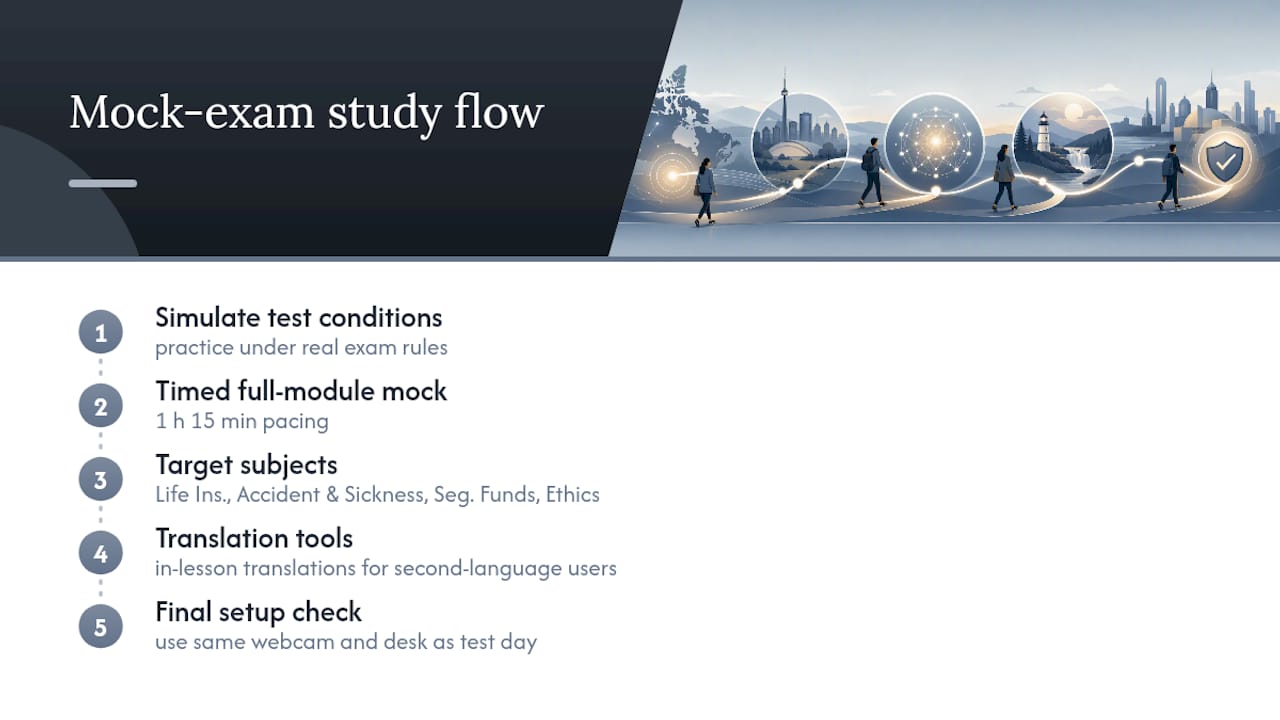
Pro Tip: Run your final mock exam using the same webcam and desk setup you’ll use on test day, not just the same content review.
What candidates actually get wrong
Most failed exam days aren’t caused by weak content knowledge. They’re caused by a name that doesn’t match CIPR, an expired ID, or a webcam that never got tested until check-in. Regulators built room scans and ID verification to catch fraud, but they end up catching disorganization far more often. A ten-minute dry run of your setup, days before your exam, prevents nearly all of it.
— Reza
Prepare for exam day with LLQPGuide
LLQPGuide gets you closer to test-ready than passive reading ever will, because you’re practising under the same pressure you’ll face whether your province tests online or in person.
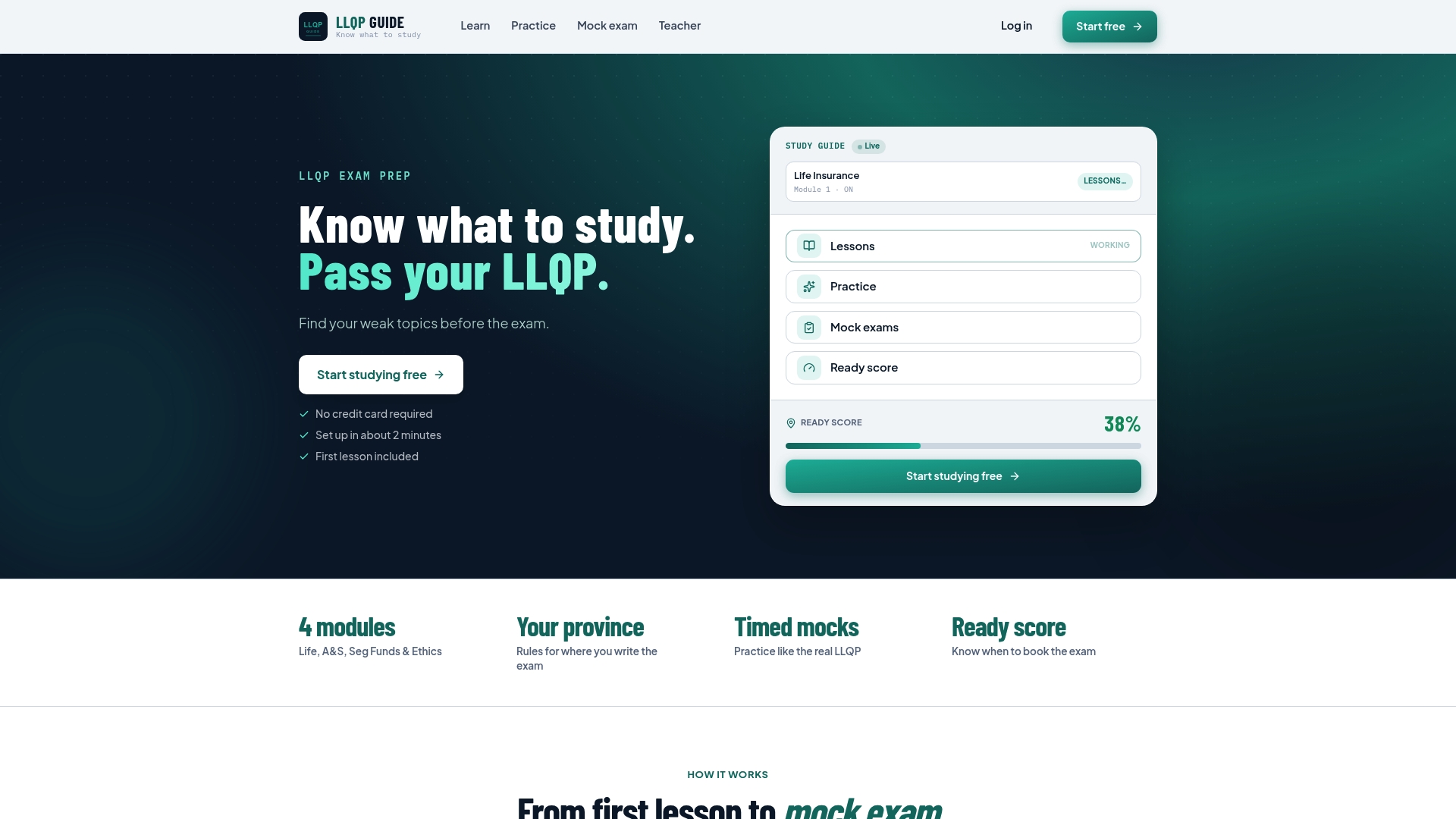
The platform’s timed mock exams mirror real module pacing, its unlimited quizzes target the modules where you’re weakest, and its translation tools mean a language barrier never costs you marks you actually earned. Whether you’re booked through Durham College or CNA, walking in having already simulated the clock, the ID check, and the module handoffs takes the guesswork out of exam day. Check the pricing page to start a free trial and build your study plan around your actual booking date.
Sources
- Steps being taken to preserve the integrity of LLQP exams | Financial Services Regulatory Authority of Ontario
- Ontario stops online Life License Qualification Program exams - Insurance Portal
- CNA exam memo 2026 — LLQP (Government of Newfoundland and Labrador)
- Life Licence Qualification Program (LLQP) | Gouvernement de l’Île-du-Prince-Édouard
Recommended
Frequently asked questions
Is the LLQP exam proctored?
Yes, though the format depends on your province. Ontario requires in-person proctoring as of July 1, 2026, while several other provinces still permit remote, webcam-based proctoring through administrators like Durham College.
Is it easy to pass the LLQP exam?
It's manageable with structured preparation, but the exam covers dense regulatory and product content across four modules, and candidates who skip timed practice under real exam conditions tend to struggle most with pacing rather than raw knowledge.
How many attempts do I get for the LLQP exam?
Attempt limits and waiting periods between rewrites vary by province, so check your regulator's specific rewrite rules before assuming a standard number of tries applies to you.
What happens if I fail my LLQP exam?
You'll typically need to wait out a mandatory period before rebooking, and some provinces charge a rewrite fee, so confirm the exact cost and waiting period with your provincial administrator rather than a generic estimate.