Avoid a one year lockout: Canada LLQP retake rules and deadlines
Avoid a one year lockout: Canada LLQP retake rules and deadlines ! Candidate confirming course eligibility at licensing office You get an initial attempt plus three supplemental attempts per LLQP module, four tries in total, and your course certification generally stays valid for about a year from completion.

Avoid a one year lockout: Canada LLQP retake rules and deadlines
You get an initial attempt plus three supplemental attempts per LLQP module, four tries in total, and your course certification generally stays valid for about a year from completion. Fail that fourth attempt and you’re looking at a mandatory waiting period plus a full course retake before you can try again. Miss the 12-month window without writing, and the same course retake applies even if you never failed a single exam.
TL;DR:
- Candidates have four total attempts per module, with at least 24 hours between attempts, and must retake the entire course if the certification expires or after four failures.
- The course validity window is typically one year from completion, and exceeding it requires retaking the course regardless of attempts made.
- Failing the fourth attempt triggers a mandatory one-year waiting period and a full course retake before attempting the exam again.
- Preparing for retakes should focus on diagnosing weaknesses with practice exams, targeting specific topics, and leaving enough time for thorough review.
- Provincial rules may vary slightly, so candidates must confirm their attempt limits, waiting periods, and course expiry dates directly with their licensing regulator.
Table of Contents
- What are the official LLQP retake rules?
- Where do provincial LLQP rules differ?
- What happens right after you fail an LLQP module?
- What does a course retake actually involve?
- How should you actually study for an LLQP retake?
- An instructor’s honest take on failing the LLQP
- How LLQP Guide helps you prepare for a retake
- Sources
- FAQ
What are the official LLQP retake rules?
The Financial Services Regulatory Authority of Ontario sets the framework most provinces follow closely: an initial exam attempt, plus up to three supplemental attempts, for a maximum of four tries per module. Fail all four and you’re required to wait a full year from the date of that failure before you can register again, and you’ll need to retake the prerequisite course from scratch.
Between attempts, FSRA requires a minimum 24-hour waiting period before you can sit a supplemental exam again. That’s a floor, not a ceiling. Some provincial insurance councils build in longer scheduling windows depending on exam centre availability, so treat 24 hours as the legal minimum rather than a guarantee you’ll get a seat that fast.
By the numbers: Four total attempts per module, a minimum 24-hour gap between tries, a 12-month course validity window, and one full year locked out after a fourth failure.
Course validity matters just as much as the attempt count. Complete your LLQP course and you typically have about a year to pass all required modules before that certification expires. Let it lapse and you’re back to square one on the course, regardless of how many exam attempts you had left.
A few practical notes worth keeping in your back pocket:
- Keep your certificate of course completion. You’ll need to present it when registering for exams, and losing track of it creates administrative headaches at the worst possible time.
- In Ontario, the LLQP exam is administered by Durham College on FSRA’s behalf, not FSRA itself. Booking, rescheduling, and in-person requirements go through the college’s exam administration process.
- Track your attempt dates in writing. Regulators don’t send friendly reminders when you’re closing in on your fourth try.
Where do provincial LLQP rules differ?
Ontario’s model, initial attempt plus three supplemental tries, a 12-month course validity window and Durham College as exam administrator is the version most candidates encounter first because Ontario represents the largest LLQP candidate pool in the country. But “most provinces follow this” isn’t the same as “every province follows this exactly,” and the gaps show up in details that matter when you’re scheduling.
Saskatchewan’s insurance council describes a comparable structure: supplemental rewrites while your training remains valid, mandatory waiting periods, and defined consequences for repeated failures. The language and mechanics track closely with Ontario’s approach, but the council’s own page is the one that governs if you’re testing in Saskatchewan.
British Columbia candidates should check the Insurance Council of BC’s exam information page directly, since registration timing and administrative requirements are spelled out there rather than borrowed from Ontario’s wording.
Quebec’s AMF and New Brunswick’s FCNB diverge more noticeably. FCNB, for instance, notes that candidates who haven’t held a licence for a set period may need to retake the LLQP course entirely, a wrinkle that doesn’t map cleanly onto Ontario’s rules.
Before booking a retake, confirm on your own regulator’s site:
- Your exact attempt count and whether any prior exams already used against your limit.
- The specific waiting period between attempts in your province.
- Your course’s exact expiry date, not an estimate.
- Whether re-registration after a licence gap triggers a course retake in your jurisdiction.
What happens right after you fail an LLQP module?
The first 48 hours set the tone for whether your retake goes smoothly or turns into a scramble. Do these three things immediately.
- Review your results breakdown. Most exam administrators provide a score report showing which topic areas you struggled with. Read it while the exam is still fresh instead of setting it aside.
- Log the exact failure date. This date starts the clock on your remaining supplemental attempts and, if things go badly, the one-year wait after a fourth failure.
- Check your course validity expiry against your remaining attempts. If your 12-month window closes before you can book and sit another supplemental exam, you’re forced into a course retake even though you technically still had attempts left.
Pro Tip: Book your next supplemental exam the same week you get your results, even if you’re not ready to sit it yet. Exam centre slots fill up, and waiting too long to reserve a date is how candidates accidentally let their course validity lapse.
The consequences compound if you’re not careful. A fourth failed attempt means a mandatory one-year wait from that failure date, followed by a full retake of the prerequisite course before you’re allowed back into the exam room. Separately, if your certification simply expires because you didn’t register for a module within the validity window, you face the same course retake requirement, even with a clean pass record.
What does a course retake actually involve?
Two situations force you back into the LLQP course: failing your fourth overall attempt on a module, or letting your course certification expire without registering for the required exams. Either way, you’re re-enrolling from scratch, and providers set their own fees for this, so costs vary by school and format.
Course formats generally break down into three options:
- Classroom instruction, delivered in person over a fixed schedule.
- Online, self-paced learning, which suits candidates juggling work or family commitments.
- Correspondence-style study, less common now but still offered by some providers.
Regulator guidance points to roughly 100 hours of study time as typical for completing the course content, though your actual pace depends on prior insurance knowledge and how much of the material is genuinely new to you.
Finishing the course resets your eligibility clock. You get a fresh 12-month window to attempt your modules again, effectively wiping out whatever pressure built up from previous failed attempts. Once you’ve completed the course, confirm with your exam administrator, Durham College in Ontario, or your provincial council elsewhere, that your new certificate is on file before you book your next exam date.
How should you actually study for an LLQP retake?
A retake demands a different study approach than your first attempt. You already know the format; what you need now is targeted repair, not another full read-through of the textbook.
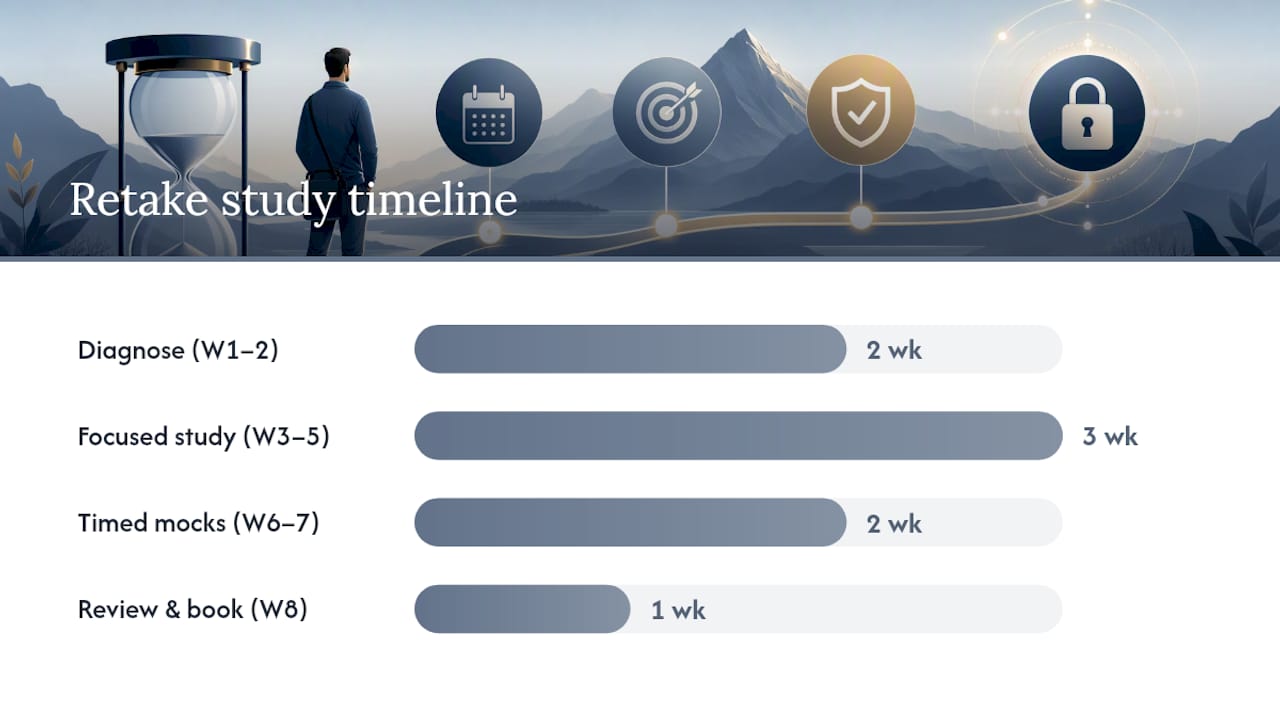
Here’s a six to eight week structure that works for most candidates:
- Weeks 1 to 2: Diagnose. Go back to your failed exam’s score breakdown and identify the two or three weakest topic areas. Don’t restudy everything equally.
- Weeks 3 to 5: Focused study blocks. Spend concentrated time on weak topics using LLQP Guide’s blog and study resources, pairing lessons with unlimited practice quizzes on those specific areas.
- Weeks 6 to 7: Timed mock exams. Sit full-length, province-specific mock exams under real exam conditions to rebuild pacing and confidence.
- Week 8: Review and book. Analyze your mock results, tighten remaining gaps, and schedule your next permitted attempt, respecting the mandatory waiting period in your province.
If English isn’t your first language, in-lesson translation tools can cut down on the time you lose decoding wording rather than answering the actual insurance question. That’s a common, quiet reason candidates run out the clock on a module without a knowledge gap being the real issue.
Pro Tip: Don’t schedule your retake the day your waiting period ends just because you can. Give yourself enough runway to finish at least one full timed mock exam first, rushing back in with the same gaps rarely turns out differently.
One more thing worth saying plainly: exam integrity gets monitored closely. Provincial councils use statistical analysis and proctor observation to flag unusual answer patterns or coordinated cheating, and getting caught carries consequences far worse than a failed attempt, including suspension from the licensing path entirely, regardless of how many attempts you had left.
An instructor’s honest take on failing the LLQP
Plenty of licensed advisors and agents working across Canada right now failed a module on their first or second try. It’s common enough that it shouldn’t feel like a verdict on whether you belong in this career.
What separates the candidates who bounce back quickly from the ones who stall out isn’t talent. It’s whether they treat the failure as data. Log your failure date the day it happens, keep your certificate somewhere you won’t lose it, and book a diagnostic mock exam before you touch a textbook again. Figure out exactly what went wrong before deciding how to fix it.
If you’re staring down a retake right now, do one thing this week: book a timed practice exam, see where you actually stand, then schedule your next permitted attempt with enough room to prepare properly.
— Reza
How LLQP Guide helps you prepare for a retake
There are other ways to prepare for a retake, rereading your original course textbook, borrowing a friend’s old notes, or hoping the second time around feels easier by default. None of them tell you exactly where you lost points the first time. LLQP Guide is built specifically for candidates in your position: unlimited practice quizzes, full-length timed mock exams, and province-specific modules that mirror the real exam conditions you’ll face on retake day.
Non-native English speakers may benefit from in-lesson translation tools across multiple languages, which matters when a wording issue, not a knowledge gap, cost you the module. Start with the free trial to pinpoint your weak areas across all four modules, Life Insurance, Accident & Sickness, Segregated Funds & Annuities, and Ethics & Professional Practice, then upgrade through the pricing page for full mock exam access before you book your next permitted attempt.
Sources
- Life Licence Qualification Program (LLQP) | Financial Services Regulatory Authority of Ontario
- Rules for exams and retakes | Insurance Councils (Saskatchewan)
- About the LLQP exam | Insurance Council of British Columbia
- Licensing Requirements - Life Licence Qualification Program | FCNB
Recommended
Frequently asked questions
What happens if I fail my LLQP exam?
You can sit up to three supplemental attempts after your initial try, four total per module, as long as your course certification is still valid and you respect the minimum 24-hour waiting period between sittings.
How many times can you take the LLQP exam?
Four times total per module: one initial attempt plus three supplemental attempts. Fail all four and you face a one-year wait plus a mandatory retake of the prerequisite course.
Is it easy to pass the LLQP exam?
Pass rates vary widely by module and preparation method, but candidates who use structured practice quizzes and timed mock exams targeting their weak areas consistently report stronger results than those relying on textbook review alone.
What should I do after passing the LLQP exam?
Confirm your certificate of completion is on file with your exam administrator, then move forward with your provincial licensing application, since passing the exam is a prerequisite step rather than the final one in becoming licensed.